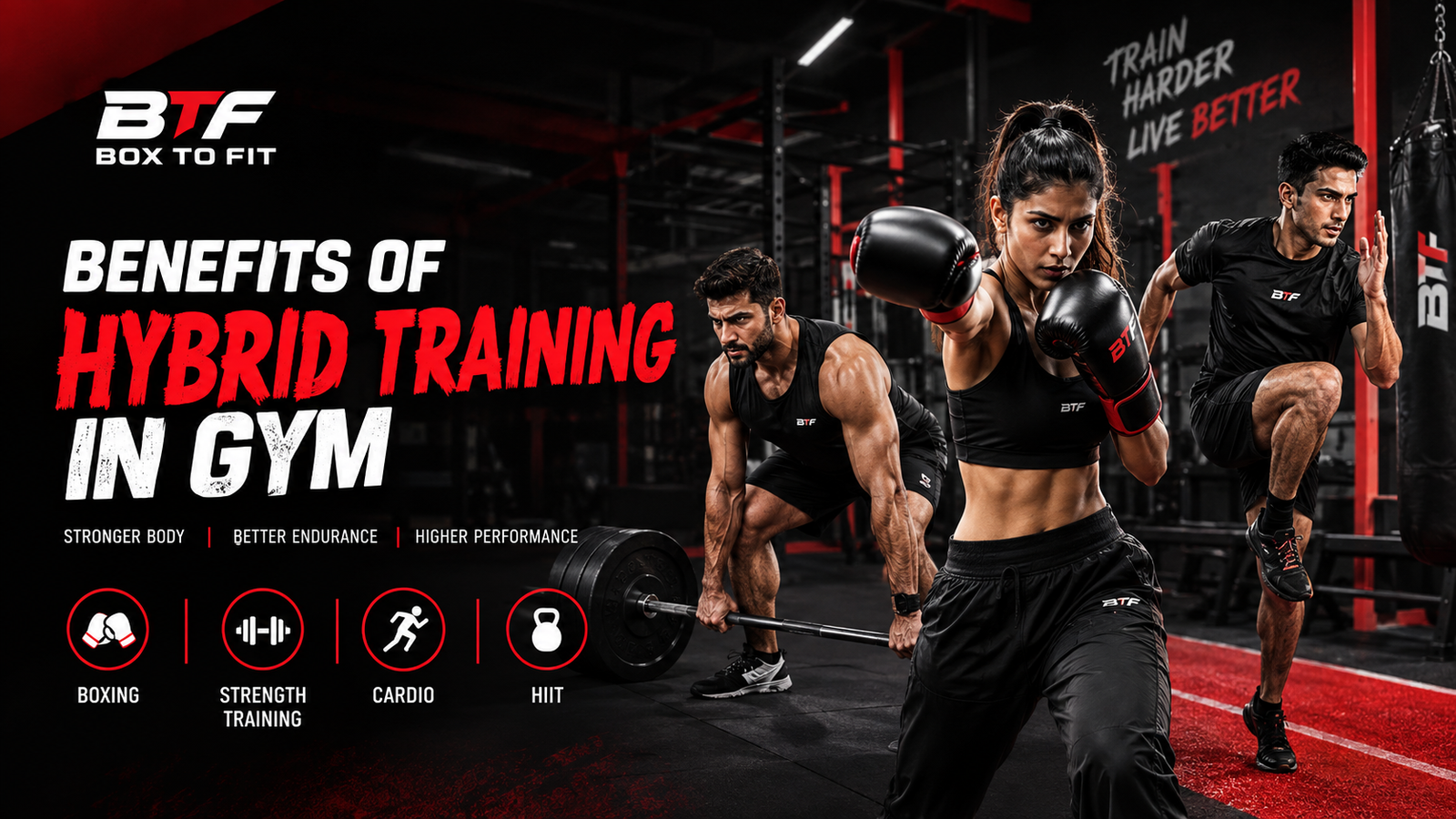
Benefits of Hybrid training in gym
September 11, 2026
Benefits of Hybrid Training in Gym: Strength, Cardio & Fitness
Benefits of Hybrid training in gym go beyond simply combining different exercises — they create a balanced approach to strength, cardiovascular fitness, conditioning, mobility, and athletic performance. At BOX TO FIT (BTF), founded by Amit (a New Zealand-based athlete and professional boxer), hybrid fitness is built around boxing, strength training, CrossFit, and HIIT in a structured ecosystem. The objective is not to make workouts harder — it is to make training purposeful, measurable, and adaptable to different fitness levels.
Follow us on Instagram and find us on Google Maps.
Table of Contents
- What Is Hybrid Training?
- Why Hybrid Training Is Becoming Popular
- 8 Key Benefits of Hybrid Training in Gym
- How BOX TO FIT Approaches Hybrid Fitness
- Who Can Benefit From Hybrid Training?
- How to Build an Effective Hybrid Training Routine
- Example Weekly Hybrid Workout Program
- Common Hybrid Training Mistakes
- How to Choose a Hybrid Gym
- Frequently Asked Questions
Experience Hybrid Training at BOX TO FIT
Boxing · Strength · HIIT · CrossFit — complete hybrid fitness in Chandigarh
What Is Hybrid Training?
Hybrid training is an approach that combines two or more fitness disciplines within a structured program. Instead of focusing exclusively on bodybuilding, running, boxing, or high-intensity conditioning, a hybrid athlete develops several physical qualities simultaneously. A typical hybrid session or weekly program might include resistance exercises, boxing combinations, interval conditioning, bodyweight movements, and cardiovascular work. This makes hybrid training benefits particularly relevant for people who want well-rounded fitness rather than specialization in one area.
Why Hybrid Training Is Becoming Popular
Traditional gym training often separates strength and cardio. The Benefits of hybrid training in gym include the ability to train multiple components of fitness within a coordinated system — particularly useful for people who want strength and endurance, individuals working toward healthy weight management, recreational athletes, busy professionals, beginners wanting varied workouts, and people interested in boxing and functional fitness.
Hybrid Training Works Best For:
1. Better Overall Fitness
One of the biggest Benefits of hybrid training in gym is the development of more than one physical quality. Strength is important, but strength alone does not determine fitness — cardiovascular endurance, muscular endurance, coordination, mobility, balance, and work capacity all contribute to physical performance. A well-designed hybrid program addresses several of these qualities throughout the week, creating a more complete fitness profile.
2. Combining Strength and Cardiovascular Conditioning
How Strength and Cardio Work Together
Strength training stimulates muscles through resistance. Cardiorespiratory training challenges the heart, lungs, and body's ability to deliver and use oxygen. These adaptations are different but complementary when appropriately programmed. A BTF-style session might include controlled resistance exercises followed by boxing intervals — the resistance component challenges muscular performance while boxing increases movement intensity and conditioning demands. The Benefits of hybrid training in gym therefore include training that is both performance-oriented and practical.
3. Supporting Healthy Weight Management
Hybrid workouts can include resistance training alongside higher-intensity conditioning. Resistance training helps maintain or develop lean muscle, while cardiovascular work contributes to overall energy expenditure and aerobic fitness. Boxing can make conditioning more engaging — at BTF, boxing is positioned not only as a combat sport but also as a fitness activity that helps people discover a more enjoyable way to exercise. Sustainable changes depend on overall energy balance, nutrition, activity level, recovery, and consistency.
4. More Variety and Better Engagement
Workout adherence matters enormously. A theoretically perfect program is ineffective if someone stops after a few weeks. Different training modalities keep sessions interesting while providing different physical challenges — boxing combinations are technically different from barbell exercises, and a conditioning circuit feels different from conventional resistance training. BTF's philosophy of making exercise a lifelong journey reflects this principle.
5. Development of Athletic Skills
Hybrid training provides opportunities to develop athletic qualities such as coordination, agility, reaction, balance, power, and movement control simultaneously. Boxing requires coordinated movement of the feet, hips, trunk, shoulders, and arms. Strength exercises build the physical foundation for force production. Conditioning work helps individuals repeatedly perform movements under fatigue — practical hybrid training benefits for people who want to feel more capable outside the gym.
6. Efficient Training for Busy People
A well-structured hybrid workout can combine resistance and conditioning components without requiring separate long sessions for every fitness objective. Efficiency comes from intelligent exercise selection and programming rather than simply reducing rest periods. For a working professional, a coach may design a session combining compound strength movements followed by short conditioning intervals — making the Benefits of hybrid training in gym particularly relevant to people with limited training time.
7. Functional Strength and Conditioning
Functional fitness focuses on movements and physical qualities that have practical applications — squats, presses, pulls, carries, jumps, and controlled bodyweight movements that develop strength and coordination across multiple joints. A suitable hybrid workout program trains both the ability to produce force and the ability to sustain physical effort. Good coaching starts with movement quality, appropriate loading, and progression.
8. A More Complete Approach to Fitness
The biggest lesson from hybrid training is that fitness does not have to fit into a single category. Someone can enjoy boxing without becoming a competitive boxer. Someone can lift weights without pursuing bodybuilding. The Benefits of hybrid training in gym come from integrating these elements according to the person's objectives — which is exactly the philosophy central to BOX TO FIT's training model.
How BOX TO FIT Approaches Hybrid Fitness
Boxing-Based Conditioning
Boxing brings technical skill into fitness training — stance, footwork, combinations, defensive movements, reaction, coordination, and conditioning. Amit's professional boxing background gives BTF a direct connection to the sport, making boxing an authentic component rather than an afterthought.
Strength Development
Progressive resistance training provides the muscular foundation for all other physical activities. At BTF, strength work is combined with conditioning rather than treated as a separate discipline — building the force production capacity that boxing, HIIT, and CrossFit movements can then express.
Functional Fitness and HIIT
CrossFit-inspired functional movements and HIIT complete the ecosystem — challenging work capacity, coordination, and metabolic conditioning in ways that complement both boxing and strength training. The result is one of the most complete hybrid fitness training environments available in Chandigarh.
Who Can Benefit From Hybrid Training?
Hybrid training can suit a wide range of people. Beginners can start with basic movements and lower-intensity conditioning. Intermediate trainees can progressively increase resistance, volume, or conditioning demands. More experienced individuals can use carefully planned hybrid sessions to improve performance across multiple domains. The key is individualization — the Benefits of hybrid training in gym are strongest when exercise selection matches the person's training history, recovery capacity, goals, and physical limitations.
How to Build an Effective Hybrid Training Routine
Understanding the Benefits of hybrid training in gym is only the first step. The real value comes from applying hybrid principles intelligently — a successful program should have a clear purpose rather than simply placing multiple difficult exercises into one session.
What Should a Hybrid Workout Include?
Warm-Up
The workout should begin with a progressive warm-up appropriate to the movements that follow — light cardiovascular activity, dynamic movements, mobility exercises, and technique preparation. The objective is to prepare the body and mind for training rather than exhaust yourself before the main session.
Strength Component
Resistance exercises should be performed with appropriate technique and progression — squats, presses, rows, deadlift variations, lunges, carries, or other resistance movements depending on the goal. Strength training provides an important foundation for hybrid fitness training because stronger muscles can contribute to performance across many activities.
Conditioning Component
The conditioning portion may include boxing rounds, cycling, rowing, running, sled work, or other suitable exercises. Intensity should match the trainee's ability — a beginner might use shorter intervals and longer recovery periods, while an experienced athlete may tolerate greater training density.
Cool-Down and Recovery
Recovery should not be treated as an afterthought. Sleep, hydration, nutrition, rest days, and sensible training volume all influence adaptation. The Benefits of hybrid training in gym cannot be maximized if every session creates excessive fatigue.
Example Weekly Hybrid Workout Program
Sample Weekly Hybrid Training Structure:
Strength + Conditioning — lower/upper body resistance followed by moderate conditioning
Boxing Fitness — technique, footwork, combinations, and controlled boxing intervals
Recovery — walking, mobility, or complete rest depending on training demands
Functional Strength + HIIT — compound movements followed by short intervals
Boxing + Strength — skill-based boxing work combined with selected resistance exercises
Conditioning — moderate cardiovascular or mixed conditioning session
Rest — complete recovery day
Hybrid Training for Beginners
Beginners often make one major mistake: trying to train like advanced athletes. The goal during the first stage should be learning movement patterns, building consistency, and developing tolerance to exercise. For beginners, Benefits of hybrid training in gym can be achieved without maximum-intensity workouts. Start with basic resistance movements, low-impact cardio, simple boxing drills, controlled intervals, mobility exercises, and adequate recovery. As technique and fitness improve, volume and intensity gradually increase.
Hybrid Training for Weight Management
Exercise plays an important role in a weight-management strategy but should not be presented as a magic solution. The Benefits of hybrid training in gym in this context include combining resistance exercise and conditioning while making physical activity more varied. Nutrition, sleep, and daily activity also matter. Boxing-based workouts can provide an enjoyable conditioning option, particularly for individuals who dislike conventional treadmill sessions.
Hybrid Training for Muscle and Strength
Hybrid training does not eliminate the need for progressive resistance training. Muscle development is influenced by training volume, intensity, exercise selection, recovery, and nutrition. A hybrid program can incorporate dedicated strength sessions while using conditioning strategically — for example, resistance training three times per week with boxing or conditioning on separate days. This demonstrates why hybrid training benefits depend on programming rather than simply exercising more.
Strength and Cardio: Can They Work Together?
Yes. Strength and cardio can coexist in the same training plan. For general fitness, most people do not need to worry excessively about interference between the two. A coach can prioritize the most important goal and arrange sessions accordingly. This is why strength and cardio training should be viewed as complementary components rather than competing ideas.
Why Boxing Works Well in Hybrid Fitness
Boxing brings technical skill into fitness training — stance, footwork, punching combinations, defensive movements, reaction, coordination, and conditioning all in one session. Amit's professional boxing background is central to BOX TO FIT's identity, using boxing as one component of a wider training ecosystem rather than treating it as an isolated discipline. This combination is one reason hybrid fitness training can be appealing to people who want their workouts to feel more athletic.
Common Hybrid Training Mistakes
Doing Every Workout at Maximum Intensity
Hard training is not automatically productive training. Constant high intensity creates unnecessary fatigue and makes recovery difficult — eventually reducing the quality of every subsequent session.
Ignoring Strength Progression
If resistance training is included but loads, repetitions, or technique never improve, strength development will plateau. Progressive overload remains essential even within a hybrid program.
Adding Too Much Volume
More exercises do not necessarily mean better results. Overloading sessions with too many movements often leads to poor technique and inadequate recovery rather than superior fitness gains.
Neglecting Recovery
Rest days and adequate sleep are integral parts of the training process. The Benefits of hybrid training in gym are built during recovery — not during the workouts themselves.
Copying an Athlete's Program
Professional athletes have different training histories, workloads, coaching resources, and recovery strategies. A general gym member should not automatically replicate their routine — always start from your own current fitness level.
How to Choose a Hybrid Gym
When evaluating a gym, look beyond equipment and social-media content. Look for qualified coaches, appropriate exercise progressions, clean facilities, clear programming, and an environment where beginners can train safely. Ask whether coaches modify exercises for different fitness levels. BOX TO FIT's model is built around combining boxing, strength training, CrossFit, and HIIT — creating a science-based training ecosystem where the Benefits of hybrid training in gym become much more meaningful when coaching and programming support the trainee's individual needs.
Start Hybrid Training at BOX TO FIT
Boxing · Strength · HIIT · CrossFit — all under one roof in Chandigarh
Frequently Asked Questions
What are the main Benefits of hybrid training in gym?
The main Benefits of hybrid training in gym include developing strength, cardiovascular fitness, muscular endurance, coordination, conditioning, and overall physical capability within one structured approach.
What is hybrid fitness training?
Hybrid fitness training combines different exercise disciplines — such as resistance training, boxing, cardiovascular conditioning, HIIT, and functional movements — within an organized program.
Is hybrid training good for weight loss?
Hybrid training can support weight management by combining resistance exercise with cardiovascular conditioning. Nutrition, total activity, sleep, and consistency also influence results significantly.
What are the Benefits of hybrid workouts?
The Benefits of hybrid workouts include greater training variety, development of multiple fitness qualities, and the ability to combine strength and conditioning within a broader weekly routine.
Can beginners do hybrid training?
Yes. Beginners can participate in hybrid training when exercises, resistance, intensity, and volume are scaled appropriately. Starting with fundamental movements and gradually progressing is generally more appropriate than immediately performing advanced workouts.
Does hybrid training build muscle?
It can. A hybrid program that includes progressive resistance training can support muscle development. Adequate protein intake, calories, recovery, and consistent training are also important factors.
Is boxing part of hybrid training?
Boxing can be an excellent component of hybrid training because it develops coordination, movement skills, technique, and conditioning. BOX TO FIT integrates boxing with strength and conditioning rather than treating it as a standalone activity.
How often should I do hybrid training?
Frequency depends on fitness level and goals. Many recreational trainees can begin with three to four structured sessions per week, while more experienced individuals may train more frequently with carefully planned recovery.
What should a hybrid workout program contain?
A balanced hybrid workout program may contain resistance training, cardiovascular conditioning, boxing or other skill-based exercise, mobility work, and planned recovery. The exact combination should reflect the individual's goals and experience.
Why choose BOX TO FIT for hybrid fitness?
BOX TO FIT combines boxing, strength training, CrossFit, and HIIT within its training ecosystem. Founded by professional boxer Amit, BTF aims to provide a structured fitness environment for athletes, working professionals, and people beginning their fitness journey — making it one of Chandigarh's most complete hybrid training destinations.


 Mon - Sat : 06:00 am - 10:00 pm (Sunday closed)
 +91 77195-60422